Key takeaways
- Specification is a design decision before it is a purchasing decision. What a chair, a work surface, or a table has to do in your space determines which product belongs there, and that gets answered well before anyone builds a quote.
- Our designers evaluate product in person. A spec sheet cannot tell you how an adjustment mechanism feels after ten minutes in the seat, or how a textile reads under the light your office actually has.
- The same evaluation runs across every vertical we serve. A university student union, a law firm, and a corporate headquarters ask very different things of the same category of furniture.
- Every named project in our gallery is the end of that process. Looking at finished spaces is the fastest way to see what specification decisions turn into.
Specification happens long before the quote
Most furniture conversations start at the wrong end. Someone counts desks, counts chairs, and asks for pricing. The count is the easy part. The decision that determines whether the space works is which product goes in it, and that decision depends on things a quantity never captures.
How many hours a day will someone sit in that chair? Is the room shared by two people or by forty? Does the surface get wiped down between users?
Then there is time. A space that has to be reconfigured in three years needs a different specification than one that has to hold its layout for fifteen. Those answers move the decision, sometimes across an entire product category.
This is why we start with space planning and design rather than a product list. Environment shapes behavior. Behavior shapes culture. The furniture is how that intention gets built, and specifying it well takes more than a catalog.
What a manufacturer showroom visit is actually for
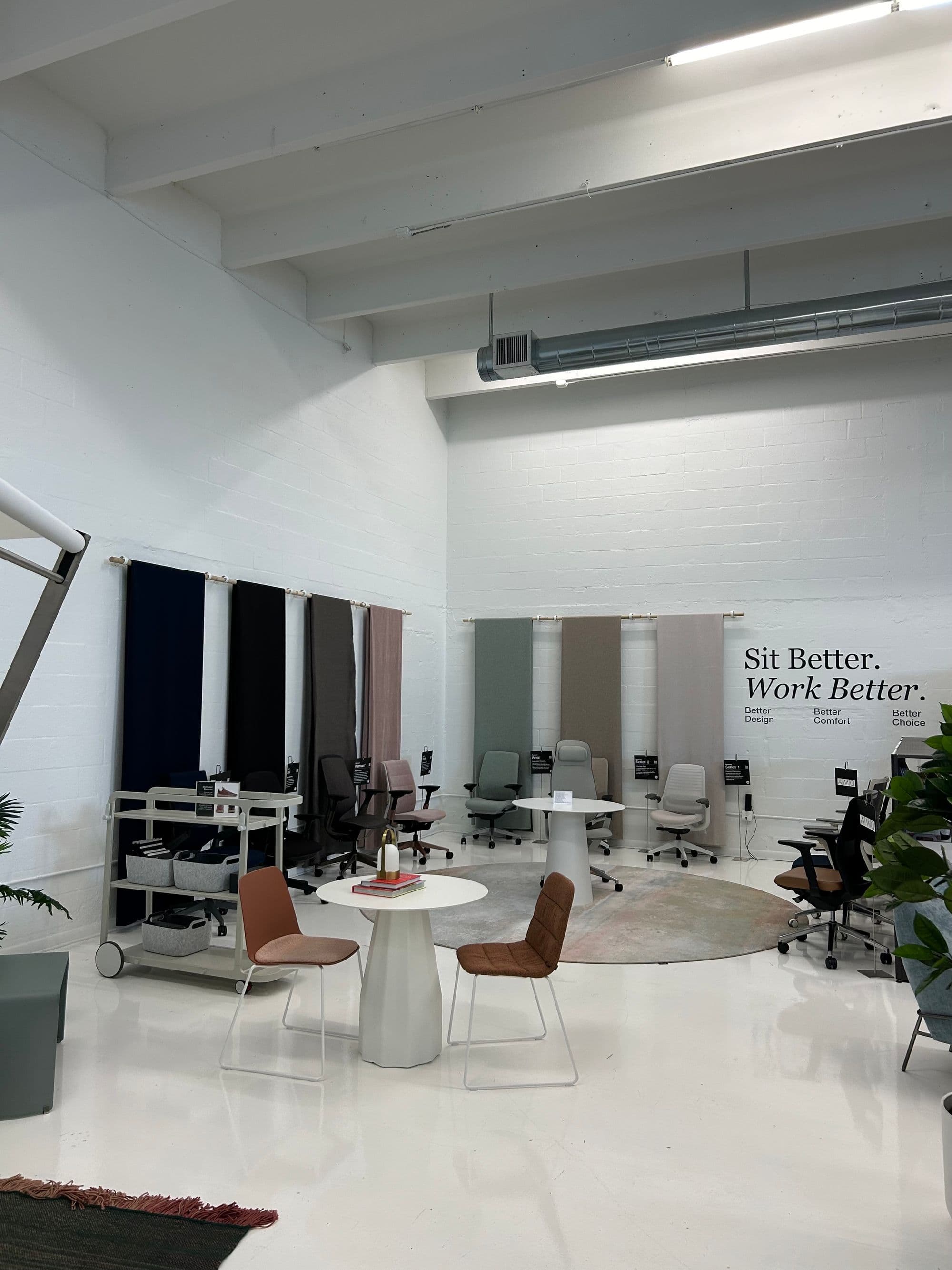
In 2024 our team visited the Steelcase showroom in Miami's Wynwood district. That showroom belongs to Steelcase, not to us. Nothing in it is our project work, and the photographs from that visit are in our gallery as reference, not as a portfolio piece. You can see them here.
Its value to a specifier is that it puts a full product range in one room, set up as real work settings instead of catalog pages. You can sit in eight task chairs in a row. You can put the same textile against six finishes and see which pairing survives daylight. You can stand at a height-adjustable surface and find out whether the mechanism is quiet enough to use in an open room.
We are a Steelcase Authorized Dealer, and time in a manufacturer showroom is part of how we keep a specification recommendation grounded in the current product line rather than in last year's catalog. You can see the rest of the lines we carry on our manufacturer partners page.
The five things our designers actually evaluate
Seating across real bodies. A chair that fits a 5'2" person and a 6'4" person differently is not one specification, it is two. Range of adjustment, seat depth, and lumbar travel matter more than the marketing name on the model.
Mechanisms under time, not under a demo. Almost anything feels fine for thirty seconds. What we are checking is whether a tilt tension holds, whether an arm stays where it is set, and whether a caster rolls the same on carpet tile as it does on hard surface.
Textiles and finishes under light. Color decisions made under showroom lighting fail in a room with a west-facing window. We look at material in more than one light condition, and we check cleanability against how the space is actually used.
Acoustic behavior. Open plan lives or dies on sound. Panel systems, felt treatments, and enclosed settings each solve a different acoustic problem, and specifying the wrong one produces a room nobody wants to work in.
Reconfiguration cost. The question is not only whether the furniture works today. It is what happens when the team grows, when a department moves, or when the layout changes. Some product families reconfigure without new parts. Some do not.
What this looks like on a finished project
The clearest way to see specification decisions is in the rooms they produced. A few from our gallery:
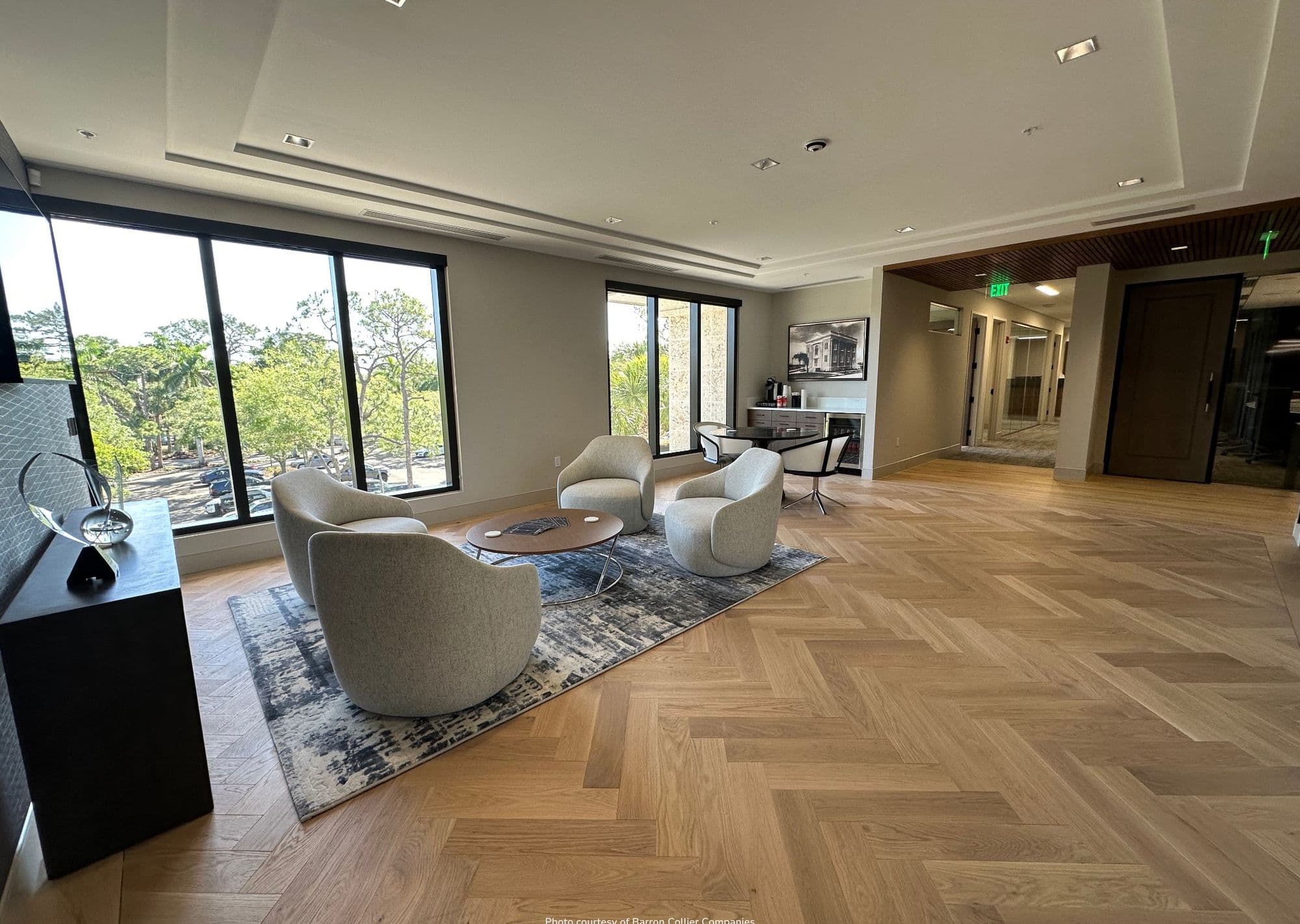
- Barron Collier Companies headquarters in Fort Myers, a corporate headquarters where the specification had to carry reception, private offices, and shared work settings under one design intent.
- Icard Merrill Attorneys & Counselors in Sarasota, a professional services environment where privacy, acoustics, and client-facing presentation drove the furniture decisions.
- Heatherwood Construction, an office headquarters covering reception, conference, boardroom, and a hybrid kitchen and office space, each with a different duty cycle.
- Mote SEA in Sarasota, a science education and aquarium environment where public-facing spaces and working spaces sit in the same building.
- FGCU Cohen Student Union in Fort Myers, a campus environment where furniture takes continuous student use and has to stay serviceable for years.
Different verticals, one method. You can see the full set on our project gallery.
Questions worth asking before you sign a specification
- Who sat in this, and for how long? If nobody on the specifying team has used the chair for more than a demo, the recommendation is coming from a catalog.
- What happens at year five? Warranty terms, parts availability, and whether the line is likely to still exist all belong in the decision.
- Who installs it, and who fixes it? We plan, furnish, install, and service with our own in-house crews, from our own warehouses. The crew that builds your space is the same crew that stands behind it.
- How does this reconfigure? Ask specifically what a 20% headcount change costs in parts and labor.
- Does the specification match the design intent, or the budget spreadsheet? Both matter. They should be reconciled deliberately, not by quietly downgrading a category nobody is watching.
Frequently asked questions
Do I need to visit a showroom to specify furniture for my office? No. Our designers do that evaluation work and bring the shortlist to you, and both of our Southwest Florida showrooms, in Fort Myers and Sarasota, carry product you can sit in. What matters is that somebody has evaluated the product in person before it is recommended.
How early should furniture specification start on a project? As early as space planning. Furniture decisions affect power and data locations, circulation widths, and acoustic strategy, and they get more expensive to change once construction documents are set.
Can you specify for more than one vertical in the same building? Yes. Mixed-use buildings routinely need different specifications for public spaces, working spaces, and shared amenity spaces. Our gallery covers corporate, education, healthcare, government, and non-profit environments across Southwest Florida.
Start with the plan, not the product list
If you are furnishing a new space or reworking one you already have, the specification is where the design intent either survives or quietly disappears. We have been doing this work in Southwest Florida since 1974, from showrooms in Fort Myers and Sarasota. Schedule a space planning consultation, or if you are an architect or designer specifying on behalf of a client, see how we work as an execution partner for design teams.